|
|
| |
|
|
| |
| |


|
The Project
Leader's Profile
Yoshihide
Tsujimoto (Ph.D.)
Professor, Department of Medical Genetics, Osaka University Medical School/Graduate School of Medicine
In 1972, graduated from the Osaka University,
School of Science. In 1977, completed
the doctoral course at the Graduate
School of Science, Osaka University
and obtained his Ph.D. In 1977, Research
Associate in Carnegie Institution,
Dept. Embryology (Baltimore, USA).
In 1979, appointed as Research Associate
at National Institute for Basic Biology,
Dept. Developmental Biology (Okazaki,
Japan). In 1983, Associate Scientist
at the Wistar Institute. In 1985, appointed
as Assistant Professor at the Wistar
Institute. In 1989, Associate Professor
at the Wistar Institute. From 1991,
he holds the current position. Specialized
in molecular and cellular biology and
biochemistry in cell death. He has
received Leukemia Society of America
Scholar (USA), Nissan Science Prize
and Osaka Science Prize etc. He is
also currently a research leader of
SORST of Japan Science and Technology
Agency.
|
Project Leader:
|
Yoshihide Tsujimoto, Ph.D., Professor, Department of Medical Genetics, Osaka University Medical School/Graduate School of Medicine
|
| Research Members: |
Yutaka Eguchi, Associate Professor, Department of Medical Genetics, Osaka University Medical School/Graduate School of Medicine
Toshiharu Shibuya, Assistant professor, Department of Medical Genetics, Osaka University Medical School/Graduate School of Medicine
Koei Shinzawa, Assistant Professor, Department of Medical Genetics, Osaka University Medical School/Graduate School of Medicine
Toshiharu Shibuya, Assistant Professor, Department of Medical Genetics, Osaka University Medical School/Graduate School of Medicine
|
| Research Collaborators: |
Yosuke Matsuoka, Visiting Assistant Professor of the 21st Century COE from Feb.1, 2007, Department of Medical Genetics, Osaka University Medical School/Graduate School of Medicine
Takashi Kodama, Post-Doctoral fellow of SORST of JST
Zheng-Guo Cui, Post-Doctoral fellow of SORST of JST
Others such as graduate students of Department of Medical Genetics, Osaka University Medical School/Graduate School of Medicine |
|


|
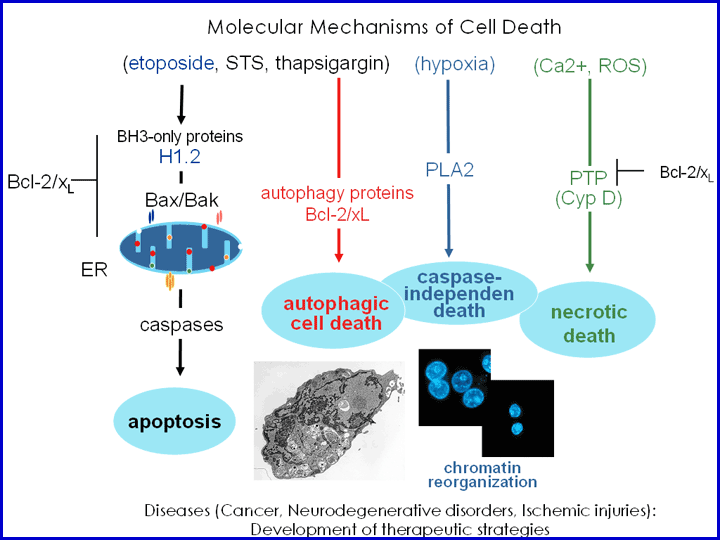
Programmed
cell death or apoptosis plays an integral
role in a variety of biological events,
including morphogenesis, tissue homeostasis,
and removal of unwanted or harmful cells.
Dysregulation of programmed cell death
leads to various diseases in humans, including
cancer and certain neurodegenerative diseases.
The mitochondria play an essential role
in the apoptotic death of mammalian cells
by releasing various apoptogenic proteins,
including cytochrome c, into the cytoplasm,
which subsequently activates death-promoting
proteolytic enzymes called caspases, that
in turn cleave a set of cellular proteins
and promote the death program. Mitochondrial
dysfunction is also an important trigger
for some forms of necrotic cell death.
The Bcl-2 family of proteins regulates
these mitochondrial changes during both
apoptosis and necrotic cell death.
We are attempting to elucidate the molecular
basis of apoptotic cell death as well as
different forms of non-apoptotic programmed
death, and aiming to develop some new strategies
for treatment or prevention of a variety
of human diseases which are caused by dysregulation
of cell death.

|
| 1) |
Nakagawa T, Shimizu S, Watanabe T, Yamaguchi O, Otsu K, Yamagata H, Inohara H, Kubo T, and Tsujimoto Y. The mitochondrial permeability transition dependent on Cyclophilin D regulates some forms of necrotic cell death, but not apoptotic cell death. Nature, 434, 652-658, 2005. |
| 2) |
Shigeomi S, Kanaseki T, Mizushima N, Mizuta K, Arakawa-Kobayashi S, Thompson CB, and Tsujimoto Y. A role of Bcl-2 family of proteins in non-apoptotic programmed cell death dependent on autophagy genes. Nature Cell Biol., 6, 1221-1228, 2004. |
| 3) |
Shinzawa K and Tsujimoto Y. PLA2 activity is required for nuclear shrinkage in caspase-independent cell death. J. Cell Biol., 163, 1219-1230, 2003. |
| 4) |
Konishi A, Shimizu S, Hirota J, Takao T, Fan Y, Matsuoka Y, Zhang L, Yoneda Y, Fujii Y, Skoultchi AI, and Tsujimoto Y. Involvement of histone H1.2 in apoptosis induced by DNA double-strand breaks. Cell, 114, 673-688, 2003. |
|
|
|
|
|
| PAGE TOP |
Copyright 2003 Osaka University. All Right Reserved.
Integrated functional analyses of disease-associated sugar chains and proteins, Osaka University

|
|
|
|
|